Sunday, September 30, 2012
STUDENT VIDEO #2: Unit G Concept 1-7
This video is about how to solve Rational functions and graph it.
The viewer to to pay attention to what I have to point out to do the problem.

Friday, September 28, 2012
Unit G Summary #10: Domain
10. While the domain of a rational function depends on DIVAH, what do you think the range of a rational function depends on? Give an example.

The range of a rational function depends on the n the horizontal or slant asymptotes because the range is the x-value so it will be involve with the y-axis. The domain and range are opposites and different. For example if f(x) is x+2/-2x then the horizontal asymptote will be -1/2 because degree on top and bottom are the same. The range of rational functions depends on the vertical asymptote. in this case x cannot be so the range would be at 0.
The range of a rational function depends on the n the horizontal or slant asymptotes because the range is the x-value so it will be involve with the y-axis. The domain and range are opposites and different. For example if f(x) is x+2/-2x then the horizontal asymptote will be -1/2 because degree on top and bottom are the same. The range of rational functions depends on the vertical asymptote. in this case x cannot be so the range would be at 0.
Unit G Summary #9: X-Intercept
9. Describe how to find the x-intercepts of a rational function. Include both the long way and the shortcut way, explaining why the shortcut makes mathematical sense.

To find the x intercept of a rational function we must get f(x) to be y and set it to equal to 0 because x-intercepts always have the y-value equal 0. If the function is a fraction type then you must divide both sides by the denominator. When y=0 that means if you multiply the denominator the it equals 0 and you can solve for x. The short cut is to skip the part of multiplying denominator to both sides and just solve for x because the denominator multiplies to zero. That way you get x faster without doing the steps.
Thursday, September 27, 2012
Unit G Summary #8: Y-Intercept
Tuesday, September 25, 2012
Unit G Summary Question #7 Limit Notations
7. Describe how to write limit notation for vertical asymptotes and what the notation means?

To write the limit notation for vertical asymptotes we must write the way Mrs. Kirch writes her limit notation for vertical asymptotes, like the one above. The one thing we have to be aware about is what the equation may be and if it may be a negative or positive infinity. The notations are + and + signs which determines if the graph may go up or down. like to show if a graph goes up you show positive infinity. Approach means arrows and f(x) is a function.

To write the limit notation for vertical asymptotes we must write the way Mrs. Kirch writes her limit notation for vertical asymptotes, like the one above. The one thing we have to be aware about is what the equation may be and if it may be a negative or positive infinity. The notations are + and + signs which determines if the graph may go up or down. like to show if a graph goes up you show positive infinity. Approach means arrows and f(x) is a function.
Unit G #6 Graphing Holes
6. How do we find the appropriate place to plot a hole if the y-value is undefined when plugged into the original equation?
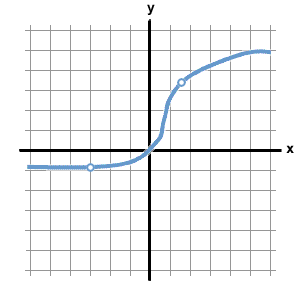
We find out where to plot a hole when y is undefined and then we plug in a zero for x. After doing that, the the remainder would be the value of x and you put the points for the graph. If you plug in zero for x than your y-intercept will be equal to the holes. When y is undefined that means that those are the holes, which is the same as the y-int.
We find out where to plot a hole when y is undefined and then we plug in a zero for x. After doing that, the the remainder would be the value of x and you put the points for the graph. If you plug in zero for x than your y-intercept will be equal to the holes. When y is undefined that means that those are the holes, which is the same as the y-int.
Unit G #5 Vertical Asymptotes and Holes
5. Describe the conditions in which a graph having a vertical asymptote and a graph having a hole?

The conditions of when a graph has a vertical asymptote and a hole is when the degree of the denominator is greater than the numerator. A hole is when something cancels from both the numerator and the denominator from the factors. When there is a hole, there is a asymptote and an x-intercept that divide the graph into two sections (though they may look connected they are not). Usually the horizontal asymptote has two x-intercepts which divides the graph into three sections instead of two, but there is only two sections when there is a hole.
The conditions of when a graph has a vertical asymptote and a hole is when the degree of the denominator is greater than the numerator. A hole is when something cancels from both the numerator and the denominator from the factors. When there is a hole, there is a asymptote and an x-intercept that divide the graph into two sections (though they may look connected they are not). Usually the horizontal asymptote has two x-intercepts which divides the graph into three sections instead of two, but there is only two sections when there is a hole.
Student Video #3
This video is about how to find and identify zeros in a 4th degree or more quadratic.
The viewer needs to pay attention to the steps in order to understand how to find the zeros in a quadratic.
Unit G Summary #4: Vertical Asymptote vs. Hole
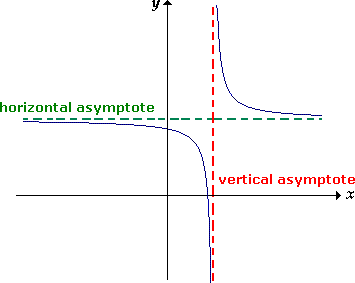
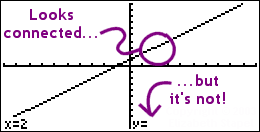
The difference is that a graph with a vertical asymptote will have dotted vertical lines because the asymptote is not part of the graph. While, for a graph with a hole, the graph will have an open circle that represents the hole of the equation, in which the graph can go through the open circle. This way although it looks connected it's really not.
Unit G Summary #3: Slant Asymtote
3. When does a graph have a slant asymptote? How do you find the equation of the slant asymptote?

A graph has a slant asymptote when one degree on the top has one bigger degree than on the bottom. To find the equation I would use synthetic division with numerator divided by denominator. The remainder however is not included because it is not needed. I but the answer into slope point form and start dotting out the graph using the Point slope equation that I got, and the denominator. I can find the y and x intercepts and make key points, which I can get using the graphing calculator.
A graph has a slant asymptote when one degree on the top has one bigger degree than on the bottom. To find the equation I would use synthetic division with numerator divided by denominator. The remainder however is not included because it is not needed. I but the answer into slope point form and start dotting out the graph using the Point slope equation that I got, and the denominator. I can find the y and x intercepts and make key points, which I can get using the graphing calculator.
Monday, September 24, 2012
Unit G Summary #2: Limit Notation for Horizontal Asymptote
2. Describe what limit notation for horizontal asymptotes actually means.


As x approaches the positive infinity f(x) will be a specific number. As x approaches a negative infinity f(x) will be a specific number. In the right side of the graph f(x) will be a number with a horizontal asymptote. As for the left it will be the same from the right as a horizontal asymptote.
Unit G summary 1 Horizontal Asymptote
1. How do we know if a graph has a horizontal asymptote? What are the three options?

We know whether or not a graph has a horizontal asymptote by looking at the degree of the numerator and denominator and we can compare the degree on the bottom and the top to find out if the degree is a horizontal asymtote. Now your options that you have to find if the graph is a horizontal asymptote, your first option is to see if you get a bigger degree on the bottom that way you can ensure the asymptote is y=0. Your second option is to see if the degree is the same, that way the asymptote is the ratio of the coefficient. The last option is to see if the bigger degree on top has no horizontal asymptote because only the middle can have an asymptote.
We know whether or not a graph has a horizontal asymptote by looking at the degree of the numerator and denominator and we can compare the degree on the bottom and the top to find out if the degree is a horizontal asymtote. Now your options that you have to find if the graph is a horizontal asymptote, your first option is to see if you get a bigger degree on the bottom that way you can ensure the asymptote is y=0. Your second option is to see if the degree is the same, that way the asymptote is the ratio of the coefficient. The last option is to see if the bigger degree on top has no horizontal asymptote because only the middle can have an asymptote.
Sunday, September 23, 2012
STUDENT VIDEO #1: Unit F Concept 10
This video is about how to do Unit F concept 10 finding all zeros with a fourth or fifth degree.
The viewer needs to pay special attention tto the step portrayed on the video.
Subscribe to:
Posts (Atom)